Never Too Late: Stolen Renaissance Painting Returned After 50 Years
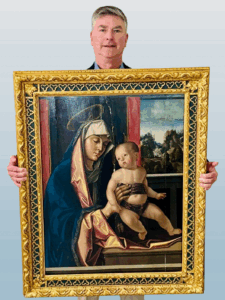 Antonio de Solario Madonna and Child
Image courtesy: Art Recovery International
When a woman in Norfolk, England, discovered that an antique painting she owned had been stolen from an Italian museum in the 1970s, she initially had no interest in returning it. Years of persuasion convinced her otherwise. On July 21, the painting, a Madonna and Child by lesser-known Italian Renaissance artist Antonio de Solario, returned to its home at the Civic Museum of Belluno in the Veneto region of Italy.
The museum had originally acquired the painting in 1872. Just over a hundred years later, in 1973, the museum was robbed, and Solario’s Madonna and Child was one of several paintings stolen. Soon after the heist, some of the paintings were located in Austria, which is where Norfolk resident Baron de Dozsa purchased the Madonna and Child to hang in his appropriately 16th-century home.
After Baron de Dozsa passed, the painting went to his former wife, Barbara de Dozsa. She attempted to sell it at a regional auction in 2017, which is when it came to the Museum of Belluno’s attention. According to The Guardian, the British police returned the painting to de Dozsa in 2020; Italian authorities could not supply the required documents to get it back, which was complicated by the COVID-19 pandemic.
Specialist art lawyer Christopher Marinello, founder of Art Recovery International and known as “the Sherlock Holmes of art crime,” contacted de Dozsa to persuade her to return the painting. At first, she refused. Under the United Kingdom’s Limitation Act of 1980, a buyer of stolen goods can be recognized as the legal owner after six years if the purchase was not related to the theft. Her former husband had bought the painting in good faith, not knowing it was stolen.
Marinello, however, called her argument “nonsense.” He believed that returning the painting was “the right thing.” He took the case pro bono; for him, it was personal, since his family comes from Belluno.
As Marinello pointed out, de Dozsa was unlikely to get any monetary value out of the painting. It is listed on stolen art databases from Interpol and the Italian national police force, Carabinieri, so if she tried to sell it, transport it to Europe, or even exhibit it, authorities would seize it. The painting’s true value, he argues, is its place in Belluno’s cultural heritage.
Ultimately, after plenty of press coverage and some persuasion from Marinello—who, in his own words, “can be annoyingly persistent”—de Dozsa agreed to return the painting. It was returned to the Civic Museum of Belluno in a small ceremony on July 21. Oscar de Pellegrin, mayor of Belluno, stated, “Returning this painting to the city means giving back a fragment of its identity, history and soul.”
In a statement from Art Recovery International, Marinello declared that “ultimately, it was Barbara de Dozsa’s decision to make, and she chose wisely. Her kindness has restored my faith in people who unknowingly come into possession of stolen or looted works of art.”
Featured Articles