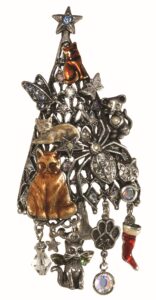
Kirk’s Folly cat Christmas tree pin, c.2005, $45-75
By Pamela Wiggins Seigel
Every holiday season, a little magical wonder starts to fill the air as we begin dreaming of Santa’s sleigh and building the best snowman ever. When it comes to capturing that essence of enchantment we look forward to year after year, costume jewelry companies didn’t make it their business to distill that sensation into a special little bauble. That is, until Kirk’s Folly came along.
It’s important to know that this brand is about far more than celebrating holidays. They market all types of jewelry dedicated to mystical creatures that go far beyond Frosty the Snowman and sprinkle their version of fairy dust around to delight their fans. Since their unique offerings coincide with the Christmas season’s distinctive charm, it’s a good time to learn more about Kirk’s Folly.
How Kirk’s Folly Got Started
The story of Kirk’s Folly is truly a homespun tale. It started in 1979 when Helen Kirk transformed a set of chopsticks into fancifully embellished hair décor named “Glitter Sticks.” Jenniefer Kirk, her sister, loved the idea so much that she shared this exciting new product with a major department store in New York City, where the sister duo began to demonstrate and sell them to eager customers. As the business grew, two more Kirk family siblings, George and Elizabeth, joined them.
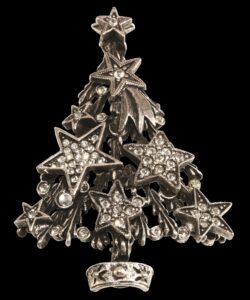
Kirk’s Folly star Christmas tree pin, c.2000, $35-65
Another big break happened in 1992 when Kirk’s Folly started offering jewelry and other gem-laden accessories to home shopping customers. Viewers tuning in embraced Jen and Helen just as much as they loved their designs featuring angels and fairies—so much so that they sold out during their first 40-minute presentation on QVC. They continued to expand their offerings on the network to every type of fantasy item imaginable, including unicorns, wizards, celestial motifs, and even “fairy dust” necklaces. These items were presented on the platform until 2014, when they abruptly closed the business.
Fans who’d been following them for years were happy to learn that Jen and Hellen Kirk revived Kirk’s Folly in 2016. They began selling in their own online shop as well as through select boutique relationships at that time. They’ve also been known to do some live shows on social media and have had a few items available on QVC again over the past few years. However, as noted on the Kirk’s Folly website, some fakes marked with their brand name have been made in China since about 2020, so buying new Kirk’s Folly jewelry from unauthorized sources (any source other than directly buying from Kirk’s Folly, QVC, or an authorized seller) could result in receiving a counterfeit item.
It’s also worth noting that the newer QVC products don’t have the panache or quality look of the older ones, even though the prices are as high (or higher) than before. Buying Kirk’s Folly secondhand offers an option to get earlier pieces that look nicer and often at better prices, too.
The Jeweled Forest
The first Kirk’s Folly Christmas tree pin I ever owned was a matte gold-tone piece expressly made for dog lovers. It had pooch faces and full-bodied canines decorating the boughs but also dangling charms any four-legged friend would appreciate like a fire hydrant and bone-shaped treat. I found out later that there are feline versions of the tree with their own unique characteristics meant to appeal to cat owners.
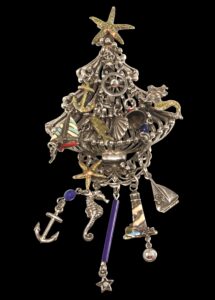
Kirk’s Folly nautical Christmas tree pin, c.2000, $75-125
In typical Kirk’s Folly fashion, however, the company didn’t rest until it had a whole passel of interests and themes adorning Christmas trees. Love spending your time at the shore? Get a nautical tree. Get your grins from gardening or gambling? They’ve got you covered there, too. Just like the animal versions, each one of these themed trees has dangling charms featuring everything from ship wheels to hand trowels, and even shoes. Being mass-produced, most of these aren’t what you would call rare, although some are easier to find than others, depending on how well they sold when they were new. A couple that bring more than average include a tree chock full of dangling butterfly charms and an Alice in Wonderland example.
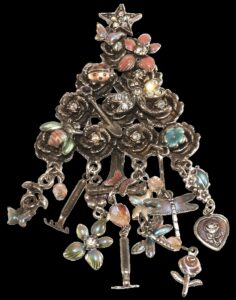
Kirk’s Folly gardening Christmas tree pin, c.2005, $75-125
There are also more traditional tree pins available, decorated with rhinestones, although some of those do have lots of dangling stars cascading from their branches. Several are signed and numbered limited-edition pieces and since they were produced in lower quantities, are not as readily available as other Kirk’s Folly trees. Competition among Christmas jewelry collectors also drives the prices up for these lovely designs.
Christmas Jewelry Beyond Trees
Even though the trees win out in terms of volume, Kirk’s Folly also made several other types of Christmas pins. My personal favorite is a large, limited-edition Santa face with dangling candy-cane shaped rhinestone elements for a beard. There are other traditional depictions of Santa available, too, while others have iridescent glass moon faces wearing Santa hats or overlooking Santa and his sleigh as he flies by on Christmas Eve. Not traditional, but interesting to say the least.
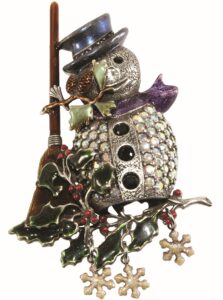
Kirk’s Folly snowman, c.2010, $45-65
This company also marketed quite a few different snowman designs that have proved popular with holiday jewelry collectors. They range from enameled versions to those decorated with lots of clear rhinestones. Some of them have components that are stacked and layered, offering complexity and dimension when compared with other snowman brooches. These apparently sold well when they were new, just like many Kirk’s Folly trees, since they come on the market fairly frequently and at a nice variety of price ranges to fit most budgets.
There are also sleighs, stockings, and a variety of charm-filled holiday pieces featuring fairies, mermaids, and other out-of-the ordinary themes. Take some time to get to know the holiday side of this brand, and you’ll understand why so many of their QVC customers became enamored with the magic of Kirk’s Folly, and collectors continue to seek the best pieces years later.
Photos courtesy of Jay B. Siegel.
PAMELA WIGGINS SIEGEL has been buying, selling, and collecting costume jewelry for more than 30 years. She is the author of Warman’s Costume Jewelry (Krause Publications) and the co-founder of Costume Jewelry Collectors Int’l, an organization dedicated to hosting events and providing educational resources for collectors. Visit her online at www.chicantiques.com and www.cjci.co.
You May Also Like:
Falling for Vintage Costume Jewelry

Winter’s Peace, painted by Bob Ross on-air on The Joy of Painting in 1993, set a new artist record with a sale price of $318,000.
Bob Ross paintings are having a major auction moment. The signature serene landscapes by the iconic host of The Joy of Painting are smashing estimates and selling for record prices. The latest took place at Bonhams in Los Angles on November 11, where three paintings by Ross sold in the “California and Western Art” auction. Together, the three works sold for $662,000, with the highest selling for $318,000, setting a new global auction record for Bob Ross.
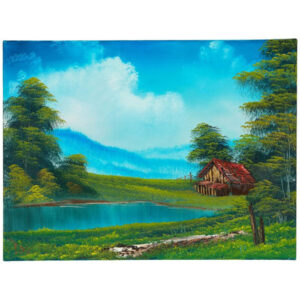
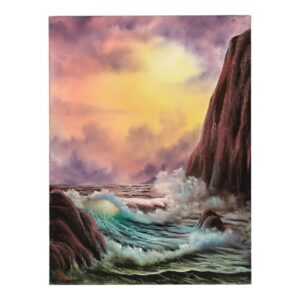
The new record was set by Winter’s Peace, a scene with the sun rising or setting in a vibrant multicolor sky over a peaceful snowy landscape with a tiny cabin and, of course, Ross’s famous “happy little trees.” The painting was made on-air in 1993 during the third episode of season 30. Ross painted Home in the Valley, a daytime scene with a house at the edge of a calm turquoise blue lake, which sold for $229,110, the same year. Cliffside, with waves crashing against cliffs while clouds turn violet in a striking yellow-orange sky, sold for $114,800. Ross painted it in 1990 for his Joy of Painting Volume 20 instructional book. A print of this painting appears on page 35.

Cliffside, painted by Bob Ross in 1990 for his Joy of Painting book, sold for $114,800.
All three paintings came from Bob Ross, Inc., which provided Certificates of Authenticity to accompany them. The proceeds will be donated to American Public Television and PBS member stations across the U.S.
Joan Kowalski is president of Bob Ross, Inc., which her parents founded after her mother took an art class taught by Ross. The company owns many of Ross’s original paintings and stores them in a warehouse in northern Virginia. Kowalski decided to sell 30 of the paintings, something she had never considered before, to raise money for public television after Congress voted in July to rescind $1.1 billion in federal funding for the Corporation for Public Broadcasting.

Home in the Valley, painted in 1993, sold for $229,110. Proceeds from the Bob Ross paintings were donated to support public television.
Bonhams is collaborating with American Public Television to sell the paintings. The November 11 auction is the first in a series that will continue into 2026, with the next auction being the American Art & Americana sale on January 27. All proceeds will help public television stations pay the licensing fees required to air beloved instructional shows like The Joy of Painting, This Old House, and America’s Test Kitchen. Kowalski believes that Ross, who loved teaching as much as he loved painting, would approve.
Certainly Jim Dunford, President and CEO of American Public Television, is “thrilled with the results,” and Robin Starr, General Manager of Bonhams Skinner, is “delighted,” according to a press release from Bonhams.
Images courtesy of Bonhams.
You May Also Like:
Bob Ross Alaskan Oil Paintings, ca. 1970, Cruise to Cool $15,000 – $20,000 Appraisals
A Happy Little Surprise: Bob Ross Painting Beats Auction Estimate

Photo: Alcynna Lloyd/ Business Insider
Antique and vintage dish sets can be difficult to sell, as many downsizers learn the hard way. But one thrift shopper’s experience suggests that more buyers may be taking an interest in fine china—and discovering its true value.
Alcynna Lloyd, a writer for Business Insider, recently documented her experience thrifting a set of dishes for $65 and learning that it could be worth $1,000. She was planning a dinner party for her birthday, inspired by videos she saw on Instagram, and needed some new dishes to accommodate her guests and fit the celebratory atmosphere. Wanting to stick to a budget, she went to secondhand store Thrift Giant to look for the perfect dishes.
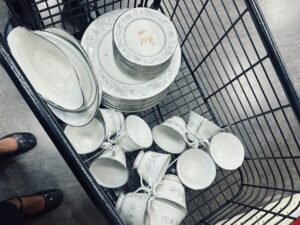
“Dishware made up the smallest section of the store, so I wasn’t expecting much,” Lloyd wrote, demonstrating the state of the market, or lack thereof, for vintage dishes. But she found exactly what she needed “on a dusty bottom shelf:” A 61-piece near-complete set of bone china plate settings and serving dishes with delicate flowers circling the rims. The set was grouped into two bundles, which sold together for just under $65.
Impressed by her find, Lloyd went looking for more information about her new dishes. They marked “Oxford,” a line of bone china developed by Lenox in the 1960s. Lenox, one of the most famous American porcelain companies, started in 1889 as the Ceramic Art Company and became Lenox, Inc., in 1906. It is active today as Lenox Corporation.
Lloyd learned that her dishes are the Spring pattern, which Lenox produced from the 1960s to mid-1980s. Looking at the prices of individual dishes in the pattern from pattern-matching service Replacements, Ltd., she was amazed to realize that assembling a set like hers would cost almost $1,000.
Just in time for the holiday season, and the parties and family dinners that come with it, Lloyd sees her adventure as part of a larger trend. She sees social media influencers promoting a love of stylishly set tables, citing Instagram stars Isabelle Heikens and Oliva McDowell and the Beautiful Table Settings group on Facebook. Thrifting and secondhand purchases in general are increasingly popular with young adults looking for bargains, trying to reduce waste, and indulging in nostalgia.
And, of course, Lloyd’s birthday party was a success, leaving her and her friends making plans for future dinner parties. Which, of course, may lead to more discoveries of the delights of vintage tableware.
You May Also Like:

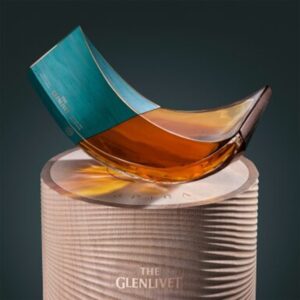
The Glenlivet SPIRA 60 Year Old 1965 whisky in a bespoke decanter by Glasstrom sold for a record £650,000 ($871,358).
When we talk about collecting liquor bottles, we usually mean long-empty containers from the 19th century. But some collectors prefer more recent bottles with the contents intact. Rare wines and spirits can be collectors’ items in themselves, sought as investments or luxuries. And they can sell for high prices, especially when it’s for a good cause. The Distillers One of One auction, held on October 10 at Hopetoun House in Edinburgh, Scotland, in partnership with Sotheby’s, is a perfect example. The charity auction of one-of-a-kind Scotch whiskies resulted in a total of £2.9 million ($3.9 million) and multiple record prices.

KANDOBLANC Dragon In Clouds 60 Year Old whisky in a hand-blown Murano glass bottle by Venini, £106,250 ($142,433).
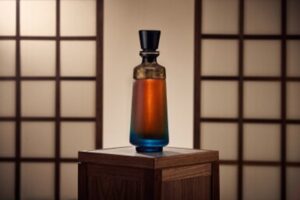
35 whisky distilleries donated bottles to the auction, which Sotheby’s Global Head of Spirits, Johnny Fowle, calls “the apex at which whisky meets art and luxury.” Many bottles that sold were works of art by contemporary glassmakers. The top lot, “The Glenlivet SPIRA 60 Year Old 1965,” which sold for £650,000 ($871,358), a record for the brand, came in a hand-blown spiral shaped decanter by UK glassmaker Glasstorm. A “KANDOBLANC Dragon In Clouds 60-Year-Old” Speyside Single Malt Scotch, which sold for £106,250 ($142,433), was bottled in a Murano glass vessel by Venini and presented in a Japanese lacquered box.

A rare Ladyburn One of One 2025 Marilyn Monroe by Sam Shaw 58-Year-Old whisky sold for £225,000 ($301,624).
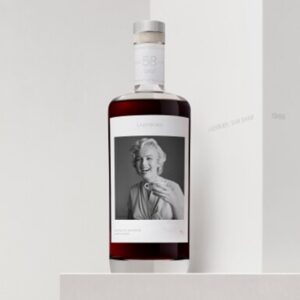
For some bottles, the appeal comes from the label. The “Ladyburn One of One 2025 Marilyn Monroe by Sam Shaw 58-Year-Old” sold for £225,000 ($301,624), a record price for the distillery, against a high estimate of £50,000. The label pictures a rare photograph of Marilyn Monroe taken by her longtime friend, photographer Sam Shaw. The contents of the bottle are extremely rare, too. The Ladyburn Distillery opened in 1966 and closed in 1975, making its products exceptionally hard to find.
This was the third edition of The Distillers One of One auction. Previous auctions were held in 2021 and 2023. The event raises money for The Distillers’ Charity, which supports disadvantaged youth in Scotland and provides grants for education and vocational training. 100% of the hammer proceeds from the auction (that is, the prices before the buyer’s premium is applied) go to charity, meaning this year’s auction raised £2.3 million ($3.1 million). This brings the total raised by all The Distillers One of One events to £6.6 million ($8.4 million).
You May Also Like:
Most expensive bottle of whisky leaves us tipsy, selling for $2.7 million.
History, hospitality, and hidden gems await.

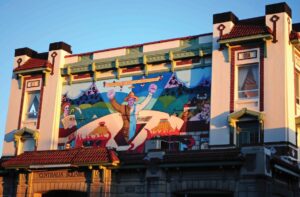
This vivid mural on Tower Avenue
honors Centralia’s labor history.
(Photograph by Richard Coit/Wikimedia Commons)
By Wayne Jordan
Antiquing in Centralia’s Downtown District
You can tell a lot about a town by what it saves. In Centralia, Washington, they’ve saved everything from carved oak dressers and Bakelite radios to century-old murals and a downtown bandstand. The past isn’t tucked away behind glass here—it’s part of the streetscape.

The historic Fox Theatre marquee.
(Image courtesy of Margot Kravette/inspiredjourneys.live)
Set between Seattle and Portland, Centralia is where the freeway finally exhales and lets you slow down for a minute. You can reach it by car off I-5 (Exit 81) or ride in on the Amtrak Cascades line, which rolls in a few times a day with curious travelers and collectors looking for a quieter kind of treasure hunt.
Downtown Centralia has that charm that happens when no one’s trying too hard. Sidewalks are wide, buildings wear their history without apology, and most shops still close for dinner. It’s a walkable place, easygoing and unhurried, with enough antique stores to keep you busy for a weekend and enough good food and character to make you want to stay longer.
Where the Hunt Begins
Tower Avenue is the heart of it all. Locals call it “Antique Row,” and for good reason. Within a few blocks, you’ll find over a dozen shops fi lled with everything from Victorian fainting couches to neon beer signs from 1973. You could walk the length of the street in ten minutes, but most folks don’t. They get sidetracked by the storefronts, the stories, the shopkeepers who know what you’re looking for before you do.
Start at the Centralia Square Antique Mall at 310 N. Tower. You can’t miss the Art Deco front, but what’s inside is the real draw: more than 130 dealers sharing one roof and not a mass-produced replica in sight. Some booths are curated like museum exhibits, others look like your grandma’s attic, and all invite digging.

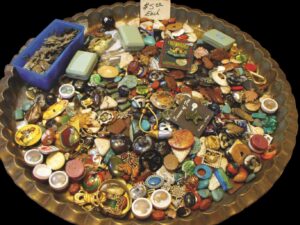
Buttons, brooches, and bits of forgotten flair from Timeless Treasures.
(Image courtesy of Timeless Treasures)
Just down the block, Timeless Treasures at 314 N. Tower lives up to the name. Housed in a former J.C. Penney’s from 1915, it still has its pressed tin ceiling and a kind of old-store smell that makes you breathe deeper. Owner Judee Smith has a knack for vintage lighting—lamps, chandeliers, sconces—but you’ll also find comics, baseball cards, jewelry, and surprises you didn’t know you were collecting until now.
If you’re into old cars, head to Junkyard 23 at 113 N. Tower. It’s heavy on nostalgia, with license plates, gas station swag, racing jackets, and toy cars that look like they’ve seen a few childhood collisions. Car culture runs deep in Centralia, and this shop reflects that.
Other worth-a-peek stops include The Landlord’s Daughter (325 N. Tower), Tower Avenue Antiques (208), The Emporium Ayala (305), and Vintage Vault (327). Each shop has its own personality and rewards patient browsing.
History on Display (and Underfoot)

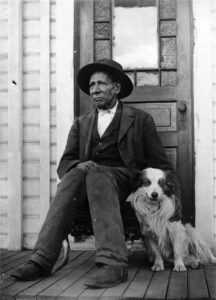
Above: Centralia, Washington, founder and Black American pioneer George Washington, seated on a stool or chair with horn legs outside the entrance to his home, with his dog c. 1890. (Washington State Historical Society)
Centralia doesn’t just sell the past, it wears it. Walk the downtown blocks, and you’ll spot murals celebrating its coal mining and railroad roots. One of the best-known spans the wall at 500 N. Tower that is heritage preserved in paint. The Fox Theater, a 1920s movie palace with an iconic Art Deco marquee, is undergoing renovation. You can’t go in now, but you can still admire its architectural flourishes and imagine the opening nights it once hosted. During the summer, they sometimes off er weekend tours for the curious.

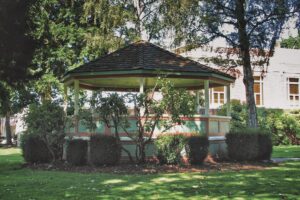
Right: The 1909 bandstand in Washington Park still holds court.
(© Steven Pavlov / https://commons.wikimedia.org/
wiki/User:Senapa)
At Washington Park, right in the middle of downtown, the 1909 bandstand still holds court. Sit on a bench nearby and close your eyes—you can almost hear the brass band warming up on a summer afternoon. It’s the kind of spot where time seems to settle in, not pass by.

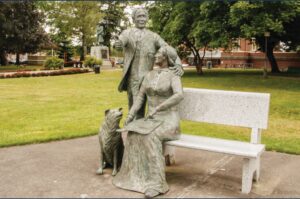
Above: Statue of George Washington with his wife Mary sitting
on a bench, with their dog, Rockwood, in Washington Park.
(Image courtesy of Margot Kravette/inspiredjourneys.live)
Want something hands-on? Check out Rectangle Gallery at 209 N. Tower for contemporary work by regional artists, or swing by Central Glassworks at 109 W. Main to watch a demo or take a short glassblowing class. Even if you don’t step behind the torch yourself, watching molten color take shape is fun.
Eat Something While You’re Here
Eventually, the hunt catches up with your stomach. When it does, you’ll find a solid mix of places to sit, sip, or scarf down something hearty.
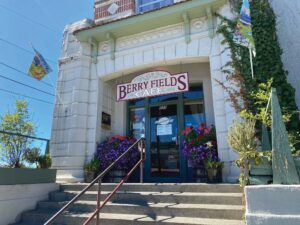
Berry Fields Café at 201 S. Pearl is a local favorite. It offers comfort food, a welcoming vibe, and a bakery case that’s hard to walk past. Try the quiche or a hot sandwich, then give in to dessert. Just do it.

Berry Fields Café
(Image courtesy of berryfieldscafe.com)
If you’re in the mood for something less grandma and more beach bar, wander around to 404 N. Tower. The Tiki Tap House delivers Island-inspired pizza, local pints, and a mellow vibe. It is perfect for relaxing after digging through vintage hardware and World War II ration books.
Seasonal Finds and Local Events
Time your visit right, and you can pair your antique quest with a lively event.
Centralia rolls out the Antique Fest in August as three days of shopping, live music, trolley rides, appraisals, vintage cars, and more. It’s not just a festival; it’s a gathering of people who love old stuff and good stories.
That same month, the Hub City Car Show takes over downtown with rows of polished chrome, rumbling engines, and proud owners ready to talk shop.

Amtrak rolls into Centralia Union Depot daily.
(© Steven Pavlov / https://commons. wikimedia.org/wiki/User:Senapa)
Come October, the town leans into its ghost stories. The annual Ghost Walk begins at the Lewis and Clark Hotel and winds through 13 historic buildings, each one paired with local legends and a little theatrical flair. When the walking’s done, there’s cider, donuts, and a pop-up bazaar full of seasonal oddities known as the “Dark Market.”
In December, the Christmas on Magnolia holiday market transforms downtown into something out of a snow globe with lights, handmade gifts, carolers, the works.
One More Thing Before You Go
You can visit Centralia in a day, but you would probably wish you hadn’t. Between the shops, the food, the walkable charm, and the stories hiding in corners, it’s the kind of place that invites lingering. So bring good shoes, carry a bag that can hold more than you planned for, and leave room in the trunk.
And don’t be surprised if, halfway through a conversation about an old curio cabinet, the shopkeeper starts telling you about their great-aunt who used to own a similar one and how she brought it west in a covered wagon or maybe bought it in a Sears catalog in 1923. Either way, the stories are free. But the memories you bring home? Those are priceless.
For more information, contact the Centralia-Chehalis Chamber of Commerce at TheChamber@ChamberWay.com or 360-748-8885.
You May Also Like:
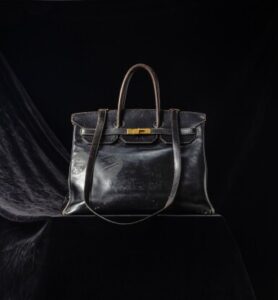
Hermès, The Original Birkin crafted for Jane Birkin. Image courtesy of Sotheby’s.
Designer handbags are some of the hottest collectibles on the market, and the Hermès Birkin may be their crown jewel. What the Birkin is to handbags, the original Birkin—the prototype bag designed for and carried by Jane Birkin herself—is to Birkins. That very bag just sold at Sotheby’s in their Fashion Icons auction in Paris, which ended on July 10. With a price of €8.6 million, or $10.1 million, it not only set a record for Birkin bags; it became the most expensive handbag ever sold at auction.
According to a press release from Sotheby’s, bidding started at a gasp-inducing €1 million, or $1.7 million. That bid was already higher than the previous world record for a handbag, $513,040 for a Himalaya Niloticus Crocodile Diamond Retourne Kelly 28 bag, also by Hermès, sold in 2021.
Morgane Halimi, Sotheby’s Global Head of Handbags and Fashion, called the sale of the original Birkin “an important milestone in the history of fashion and the luxury industry more widely” and “also, ultimately, a celebration of the enduring spirit and appeal of its muse, Jane Birkin.”
Actress Jane Birkin (1946-2023) inspired the bag that bears her name after encountering Hermès head Jean-Louis Dumas in the early 1980s. The two met on a flight where Birkin, struggling with her carry-on bag, commented on how hard it was to find a bag that held everything she needed, especially as a young mother travelling with children. She and Dumas discussed what would make the perfect practical, stylish bag. They are said to have drawn sketches on the plane’s airsickness bags. In 1985, Hermès completed a prototype based on Birkin’s ideas and presented it to her as a gift, asking permission to name it after her.
The bag quickly became part of Jane Birkin’s image. Sotheby’s describes it as being “in the exact condition in which it was last used by Jane,” and it bears many marks of her life, style, and activism. Her initials, “J.B.” are branded on the leather just under the clasp, and her nail clippers are still attached to the strap. A close look shows the marks left by stickers promoting Unicef and Médecins du Monde, among her favorite causes.
The original Birkin has been sold at auction twice before. In 1994, Jane Birkin donated it to a charity auction for Association Solidarité Sida, which supported AIDS research and promoted awareness. It went to auction again in Paris in 2000, where a collector and dealer, Catherine B, purchased it.
In the essay “What It’s Like to Own the Original Birkin,” published on July 3, Catherine B. told Sotheby’s, “Auctions back in the 2000s were nothing like they are now, with all the technology to assist bidders. I was determined to keep a low profile…I called in to an expert on the phone.” She described the auction as “like a poker game without the cards,” also apt description for this sale. Bidding lasted ten minutes, with nine collectors competing over the phone, online, and in the room. The winning bid came over the phone from a private collector bidding through Maiko Ichikawa, Country Head of Sotheby’s Japan, and the room broke into applause.
Khaleej Times, the leading English-language newspaper in the United Arab Emirates, confirmed the buyer’s identity in an exclusive report published on July 14. Shinsuke Sakimoto, CEO of Valuence Holdings Inc., a self-described “Circular Design Company” listed in Japan that trades in pre-owned luxury items, cast the winning bid. Valuence intends to display the bag, recognizing that its cultural value is as important as its monetary value.
The original Birkin has been displayed twice in major museum exhibitions. It appeared in the “Items: Is Fashion Modern?” exhibit at the Museum of Modern Art in New York in 2018 and the 2020 “Bags Inside Out” exhibit at the Victoria and Albert Museum in London. Catherine B., who owned the bag then and loaned it to the exhibitions, believes “Every cultural object deserves its retrospective, its chance to exhibit its non-market value in our daily lives.” In a departure from many collectors’ view of designer bags as investments, she says, “I see handbags as traditional works of art, and as such they deserve homage in museums.” With its Hermès craftsmanship, its place in fashion history, pop cultural status, and its truly one-of-a-kind provenance, no bag may fit that description quite like the original Birkin.
Raise the Glass to Retro Shakers
By Kris Manty
Part of the enjoyment of having a cocktail is the ritual of making it. Shaking a drink and creating a rhythmic rattling of ice on metal has long been a quintessential technique in a bartender’s repertoire for blending ingredients.
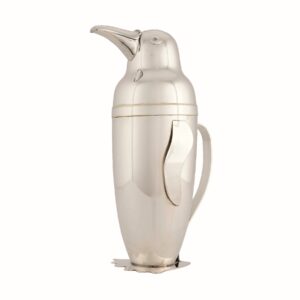
And making a drink in a sleek cocktail shaker resembling a skyscraper or otherwise whimsically shaped adds extra flair. That’s one of the things collectors love most about vintage shakers: their sense of theater. Preparing a cocktail in a silver Art Deco penguin and pouring it out through the beak enhances the process in a showy way a regular shaker can’t.
Once a symbol of luxury and refinement, people now collect cocktail shakers because they represent a bygone era of sophistication. They recall a time when the art of crafting a cocktail was practiced in homes worldwide, and a host’s merit was judged not only on their skills in the kitchen but also on their ability to produce a well-shaken martini that even James Bond would approve of. Shakers are also seen as unique pieces of art, and collectors will pay thousands of dollars for the best examples.

The high-end cocktail shakers and accessories produced by luxury American brands, including
Gorham, International Silver Company, Napier, Revere, and Tiffany & Co., solidified
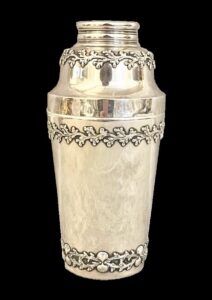
their status as symbols of sophistication among the wealthy. This Tiffany & Co. sterling silver
one-pint shaker, with a decorative relief of branches and shells, sold at auction in 2025 for
$8,320. Sloans & Kenyon
Shakers Through History
According to Tales of the Cocktail Foundation, mixing drinks dates back to 7000 B.C., as was proven after archeologists found traces of alcohol in fragments of a gourd in South America. The first reference to a drink being made in a tubular vessel was in a letter Spanish explorer Hernando Cortez wrote in 1520 about cacao mixtures made in a “golden cylinder-shaped container.”
But it wasn’t until the mid-1800s that the cocktail shaker as we know it became a bar staple. The first shakers were plain metal cups, which inventors and bartenders continuously improved upon and developed three main types: the simple two-piece Boston, a favorite with bartenders for its ease of use; the sleek two-piece French (or Parisian); and the classic three-piece Cobbler, which is what most people envision when thinking of cocktail shakers.
The pinnacle of cocktail shaker design is widely considered to be from 1920 through the late 1930s when Prohibition and the rise of cocktail culture coincided.
After Prohibition took eff ect in 1920, banning the manufacture, transportation, and sale of liquor, drinking establishments were outlawed and replaced by clandestine speakeasies. Americans also imbibed more often in their homes, causing skyrocketing demand for stylish cocktail shakers and other barware.

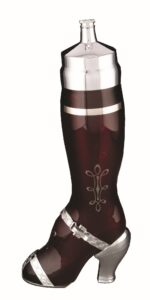
Provocative and playful, this 1937 ruby glass cocktail
shaker by Derby Shelton Silver Co., takes the form of
a lady’s leg in a high-heeled shoe. It sold
for $1,750 in 2021. Heritage Auctions
The thirst for new designs led to a proliferation of cocktail shakers. Art Deco and the skyscrapers blanketing New York City’s skyline influenced some of the most beautiful and expensive. Plenty of novelty shakers were made resembling animals, airplanes, artillery shells, golf bags, lighthouses, musical instruments, a woman’s leg strapped in a high-heeled shoe, and zeppelins balanced on their tail fins.
After Prohibition was repealed in 1933 and liquor became readily available again, the demand for display-worthy barware continued growing. Many pieces were made in the new Streamline Moderne design with its industrial aesthetics. By the end of the decade, cocktail shakers were common objects affordable for all.
Though World War II temporarily halted the production of metal shakers as resources were redirected, post-war prosperity revived cocktail culture during the 1950s. Shakers again became a staple for home bars, and designs reflected the midcentury style with bold colors and geometric patterns. However, when electric blenders and simpler highball-style drinks that were mixed directly in glasses became trendy, cocktail shakers and their accompanying rituals and showmanship were relegated to the sidelines.

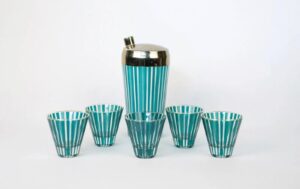
Some of the most affordable cocktail
shakers are those from the midcentury, which can commonly be
found for under $100. This set from the 1950s-1960s includes a shaker
and five glasses, all decorated with vertical stripes in teal, a
quintessential MCM color. The set sold for $85. Fair Auction Company
They surged in popularity again with the revivals of cocktail culture in the late 20th century and during the COVID-19 pandemic when people rediscovered the artistry of crafting drinks at home.
Today, cocktail shakers remain appreciated for their history, craftsmanship, and nostalgia.
The Most Collectible Cocktail Shakers
Today, collectors can find a wide array of antique and vintage shakers at auctions, antique stores, estate sales, flea markets, and e-commerce sites like eBay, Etsy, and Ruby Lane. They range from aff ordable mid-century pieces, many of which are $50 and under, to the Art Deco and Streamline Moderne examples made in the golden years; these are the most popularly collected and can sell from $500 to more than $10,000 and in some cases, even six figures. They generally command the highest prices for their exemplary artistry and their rarity — pieces were produced by hand or in small quantities, making them unicorns.
Two quintessential and avidly sought-after designs inspired by Art Deco skyscrapers are those by Louis W. Rice and Norman Bel Geddes.

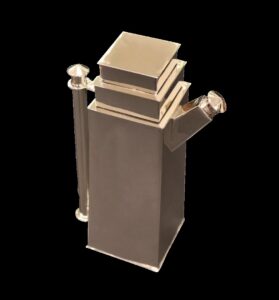
Louis W. Rice’s Skyscraper cocktail shaker, 11 in. h, was
first designed in the 1920s and has a handle and spout that
resemble smokestacks. It’s one of the rarest and most valuable
today. This example sold for $11,520 in 2024. SS Auction, Inc.
First created in the early 1920s, Rice’s “Skyscraper” shaker features a stepped architectural form, handle, and spout resembling smokestacks. Prices reflect its scarcity: in 2021, a piece from the Apollo Studios line, circa 1928, sold for $17,500 at Heritage Auctions, a record price for Rice.

With its sleek lines and gleaming chrome, Norman Bel Geddes’
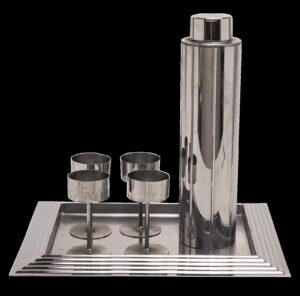
“Manhattan” cocktail set, designed in 1934 for Revere Copper and Brass Company,
features a tall, cylindrical shaker and accompanying stemmed
cups that can be arranged like architectural elements on a
serving tray. This set sold for $3,724 in 2025. Capsule Auctions
With its sleek lines and gleaming chrome, Geddes’ “Manhattan” cocktail set designed in 1934 for Revere Copper and Brass Company features a tall, cylindrical shaker and accompanying stemmed cups. A set sold for $25,000 at Heritage Auctions in 2021, while a single Manhattan shaker sold for $22,500 also in 2021 at Heritage. Listings on eBay and LiveAuctioneers.com show that over the past few years, other Manhattan sets have sold between $1,200 and $8,750, while single shakers have fetched between $500 to $1,000.
These are also among the most valuable pieces that shake up collectors:

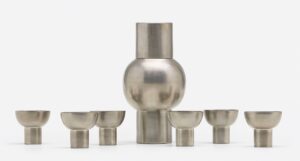
Pewter cocktail sets by American designer Russel Wright, embodying
the 1930s’ Streamline Moderne style, were handcrafted, making
them exceedingly hard to find today. Prices reflect that: this rare
early set, circa 1930, sold at auction in 2019 for $125,000. Wright
Russel Wright’s sets: This American designer, known for creating history’s best-selling American ceramic dinnerware, also designed various cocktail items. Wright’s celebrated pewter cocktail sets, made in diff erent variations, embody the 1930s’ machine-inspired streamlined approach to American design. They were completely handcrafted and never mass-produced, making them exceedingly hard to fi nd. One of his early sets, circa 1930, sold at Wright Auction for $125,000 in 2019, while his 1930 “Hour Cocktail Set” sold at Heritage Auctions for $5,250 in 2021. One of his solo shakers, made of aluminum and with a teakwood top, sold on eBay in 2024 for $5,000.

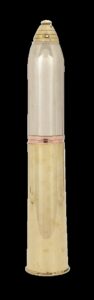
One of the most famous cocktail shakers is Gorham’s artillery shell that’s a copy
of a World War I “eighteen-pounder” shrapnel shell. The silverplate, brass,
and copper shaker stands 22-1/4 in. h. This piece sold for $5,120 in 2023.
New Orleans Auction Gallery
Gorham’s Artillery Shell: Gorham Manufacturing Company, highly influential during the heyday of American silver production, produced many collectible shakers, the most famous being a facsimile of the WWI 18 pounder shrapnel shell. Manufactured around 1915 and made of silverplate, brass, and copper, the shaker is 22-1/4 inches high; a smaller variation made later is 12 inches high. These shakers have sold between $350 and $4,000 in the past several years.

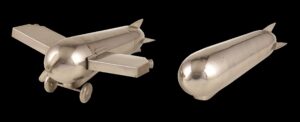
J.A. Henckels’ Zeppelin cocktail shaker (at right) is one of the most
iconic Art Deco shaker designs. The company also made other forms, including
this airplane. These circa 1930 silver-plated brass shakers are
more like traveling bars, as each feature four cups, a spoon, a flask,
a funnel with stopper/corkscrew, and a strainer/juicer. The airplane also
includes two flask wings. The duo sold for $22,500 in 2022. Rago
J.A. Henckels’ Zeppelin: Renowned for its premium kitchen knives, this German company also produced one of the most revered Art Deco shaker designs in 1928—the Zeppelin. Its glossy, curvaceous body holds unexpected accessories, including four cups, a strainer with a juicer, a funnel, a decanter, a muddler, and a corkscrew. These have sold between $500 and $4,000 over the past few years.

Emil A. Schuelke’s novelty penguin cocktail
shaker from 1936 was one of the most
popular of the Jazz Age and it remains popular
with collectors today. This one, 12-1/2 in. h, sold
in 2025 for $2,032. Wright Auction
Emil A. Schuelke’s Penguin: One of the most popular shakers of the Jazz Age was the whimsical penguin Schuelke designed in 1936 for the Napier Company, esteemed for its jewelry and silver items. The silver-plated brass penguin has a hinged beak that cleverly serves as a pour spout. These have sold between $450 and $3,500.

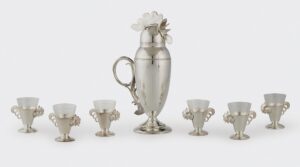
A Wallace Brothers’ Rooster cocktail service, circa 1928,
consisting of one cocktail shaker and six cups, sold for
$8,820 in 2025. Wright
Wallace Brothers’ Rooster: A major American silver manufacturing company, Wallace Brothers’ hand-hammered, silver-plated rooster cocktail shaker from 1928 is something to crow about. With its fancy curved-tail handle and a tongue that unscrews to pour the drink, it beautifully melds form with function. Some of these shakers come with matching cups that have rooster heads and tails. Shakers have sold between $500 and $2,500 in the past few years, while sets are particularly rare and pricey: one sold at Wright Auction for $8,820 in 2023.
Vintage shakers are a fun way to add style to your bar or to use as decorative pieces in your home decor. From their ancient roots to their role in shaping modern mixology, they are a testament to creativity and innovation and continue to elevate the art of the cocktail.
You May Also Like:
By Elizabeth Heineman
Fans of Twin Peaks, Eraserhead, and Mulholland Drive will have the chance to bid on items from celebrated filmmaker David Lynch’s personal archive at Julien’s Auctions.
When filmmaker David Lynch passed away in January 2025, he left a legacy of creativity and an extensive collection. On June 18, Julien’s Auctions and Turner Classic Movies will present The David Lynch Collection, a live auction of over 400 items from Lynch’s personal archive. The auction will take place at The Peninsula Beverly Hills and will feature in-person and online bidding.
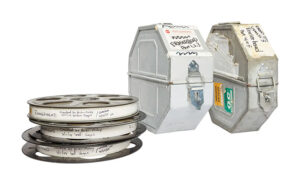
David Lynch’s personal 35mm print of his groundbreaking debut feature film Eraserhead (Libra Films, 1977).
Lynch’s first feature-length film, Eraserhead, was released in 1977 after a lengthy production. It established his surreal, experimental style and quickly became a cult success. A 35mm print of the film, consisting of five 14.5-inch reels, is up for auction with a presale estimate of $500-$700. As of this writing, bids have passed $27,000!
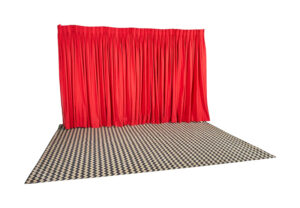
“Twin Peaks” Black Lodge Style Red Curtain and Zig-Zag Rug.
The television show Twin Peaks, which ran from 1989-1991, may be Lynch’s best-known work. He revisited its strange world with a prequel film released in 1992 and a sequel series in 2017. A red curtain and black and white zigzag rug matching one of the show’s most memorable and eerie locations, the Black Lodge, has bidders in a frenzy, already reaching $17,500 against an estimate of $1,000-$2,000. Blurring the lines between art and life, Lynch had curtains and rugs like this in his home.
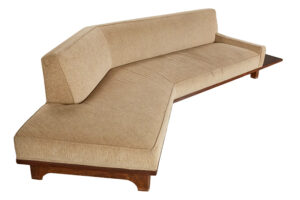
“Lost Highway” Style Boomerang Sofa
Another piece that may have appeared in Lynch’s home and work is a vintage sofa in the style of Adrian Pearsall’s iconic Boomerang design. A sofa like this one, albeit with a different finish and upholstery, appeared in Lynch’s 1997 film Lost Highway.

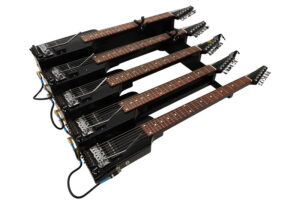
Danny Ferrington Custom Five Neck Console Guitar Designed and Studio Played By David Lynch.
Music has always been integral to Lynch’s work; many albums that inspired him and instruments he played are up for auction. The most notable may be a five-neck guitar custom-made or Lynch by renowned luthier Danny Ferrington.

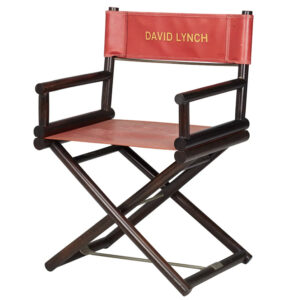
Personalized Director’s Chair.
Possibly the most emblematic—and highest-priced item in the auction is a director’s chair personalized with Lynch’s name. Estimated at $5,000-$7,000, bids have already reached $30,000.

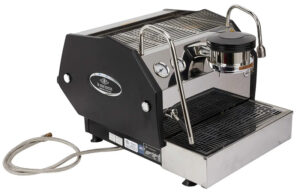
La Marzocco GS/3 Home Espresso Machine (A)
Other lots include screenplays, props, cameras, lighting equipment, books on film and photography. Several of Lynch’s personally used coffeemakers, including a top-of-the-line La Marzocco espresso machine. According to Julien’s, Lynch “could never be more than 15 steps away” from a cup of what one of the most famous characters he wrote, Dale Cooper of Twin Peaks, called “damn good coffee.”
Photos courtesy of Julien’s Auctions.
You may also like:
Millions Paid for Rock Star’s Guitar
Autographed by Cobain, Novoselic, and Grohl, the LP was obtained after a 1991 Bristol gig and remained in storage for over 30 years.

Vinyl / Autograph – Nirvana – fully signed copy of the 1991 Nevermind LP. It is possibly the best-signed example in terms of presentation and provenance to ever come to market, with the clear signatures of Kurt Cobain, Dave Grohl, and Krist Novoselic centered on the front of the album sleeve and in fantastic large writing. Image courtesy of Wessex Auction Rooms.
An LP of Nirvana’s Nevermind with an autographed sleeve, kept in a loft for 30 years and called a “collector’s dream,” sold for £18,600 ($24,552) at Wessex Auction Rooms in Wiltshire, UK, in its Vinyl Records & Music Memorabilia auction on April 16.
The sleeve is signed by lead singer Kurt Cobain, bassist Krist Novoselic, and drummer Dave Grohl. Auctioneer Martin Hughes called it “possibly the best-signed example ever to come to market” and noted that “Full sets of Nirvana signatures from this period are extremely rare, and to have them signed so perfectly on the sleeve of the most iconic album is a collector’s dream.”
Nevermind, released in 1991, is widely considered one of the best and most significant albums in rock music history. As Nirvana’s second album and their major label debut, it catapulted the band to global stardom and marked a turning point in pop culture, making grunge and alternative rock the dominant styles. Even the album cover, designed by Robert Fisher with the photograph of an underwater baby shot by Kirk Weddle, is an icon; today, it is in the design collection of the Museum of Modern Art.
The owner of the signed album got it autographed after Nirvana’s performance at the Bierkeller in Bristol, England, on November 4, 1991. He said that he and his friends “knew the guys who ran the Bierkeller” and “were also friendly with the door staff,” so they got to meet the band personally before they went to the stage door. “We wanted them to ourselves for five minutes.”
The concert was the first UK date on the band’s Nevermind tour. The venue held only 700 people and was at full capacity for the concert. Andy Fox, a manager at the Bierkeller at the time, later recalled to the Bristol Post “The build-up to it was crazy, there were loads of people outside the venue all day trying their best to get in, but it had sold out ages ago.”
The signed album doesn’t just capture a major moment in pop culture. It’s a memento of a beloved part of Bristol’s history. The Bierkeller closed in 2018, but fans treasure their memories of the venue and its live music shows. Hughes said “As a Bristol man myself, the local connection is also exciting for me,” and “That Bristol Bierkeller show is the stuff of legend.”
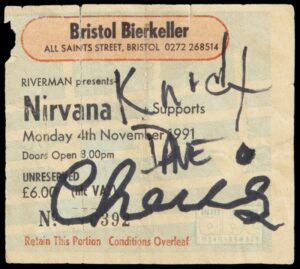
Nirvana: Band-Signed 1991 Bristol England Concert Ticket Stub. Image courtesy Julien’s Auctions.
In 2015, Time Out ranked the Nirvana show among “eight Bristol gigs that will go down in history.” A ticket from the show, also signed by the band members, sold at Julien’s Auctions in 2022 for $10,240, doubling its high estimate of $5,000. Not a bad return on investment; admission to the concert was only £6!
You may also like:
Music Poster Sets Record Price